
Unlocking the True Potential: The Impact of Lumber Grade on Board Foot Calculation and Project Costs
Whenever starting on a woodworking project, be it assembling a custom bookshelf or a house, lumber grade will be necessary in computing the board feet correctly and in project cost management. The lumber measuring system is developed to make sure that the builders and craftsmen receive appropriate quantity of material to use without wasting and extra expenditures.
This article will discuss the effect of lumber grade on the determination of board feet, project expenses, and the overall price of lumber, and in the process, we will also give tips on how you can choose the correct lumber to use in your wood working projects. We will also talk about how lumber grades may help in optimizing lumber efficiency and lessening wastage of materials in lumber.
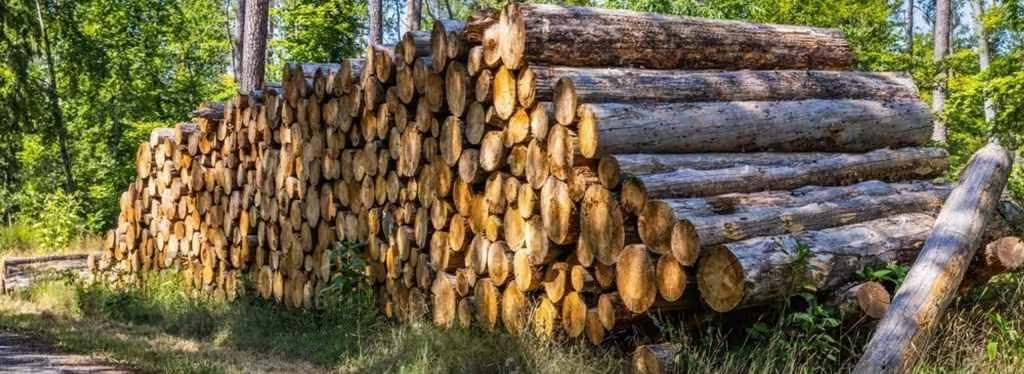
What is Lumber Grade and Why Does It Matter?
The grade of Lumber is the quality of the wood in relation to some of its properties such as strength, look and blemishes. The suitability of the wood to a number of applications is determined by the various lumber grades including FAS Lumber, #1 Common Lumber, and the #2 common Lumber.
For example, the FAS Lumber (First and Seconds) is the highest grade of hardwood that gives the cleanest and strongest boards. It is commonly used in fine woodworking and custom furniture lumber projects. #1 Common Lumber and #2 common lumber are lower grades and may have more lumber defects including knots, splits, and cracks. These grades are useful in knowing the calculation of the board foot and eventually influences your estimate of the lumber costs.
What is the effect of lumber grade on the calculation of board foot?
When you are calculating board feet you are calculating the wood volume that you require for your project. But the grade of lumber will determine the amount of usable wood that you will actually get. Lower grade lumber such as #2 Common Lumber may contain more defects thus resulting in you having more wastage. This does not only influence the calculation of your board foot, but may generate extra expenses in materials.
Conversely, FAS Lumber offers better yield of useful wood with lesser defects which means that there is better utilization of the materials and less lumber is wasted. Therefore, FAS Lumber may be more expensive when compared to the price per board foot but in fact it may be used to save on the total cost of the project because of reduced wastage.
This is the basic formula of board foot calculation:
Board Feet (BD FT) = (Thickness in inches x Width in inches x Length in feet) ÷ 12.
Example of Board foot calculation involving various grades of lumber
FAS Lumber Example:
Suppose we had FAS Lumber measuring 10 feet in length, 6 inches in width and 1 inch in thickness. Using the formula:
(1 x 6 x 10) ÷ 12 = 5 board feet
Since FAS Lumber is less defective and therefore all the 5 board feet could be usable.
#2 Common Lumber Example:
This time we will select a #2 Common Lumber, it has some imperfections in it. You might have to eliminate some boards because of defects, i.e., of the 5 board feet, only 4 might be usable, and this creates more of waste in the lumber and extra expenses.
The role of lumber defects in the cost of the project
Lumber defects present in lower grades such as the #2 Common Lumber compromise the project quality. Defects such as knots and cracks may be suitable in the case of framing lumber, but they are not suitable in the case of custom furniture lumber, where not only aesthetics but also strength are vital factors.
In case your project is dealing with woodworking projects which involves high quality of wood, it may help to use high quality of lumber like FAS Lumber which would mean that you are using high quality wood, as a result, there would be less wood that goes to waste which has a defect. This assists in checking the lumber waste minimization and enhances efficiency of the lumber in general.
Lumber Selection Tips for accurate Lumber cost estimation
The lumber grade is the most important element in ensuring that you do not over or under estimate the size of wood you require. Proper cost estimation of lumber is one aspect that would make sure that you do not go above your project budget and also you would not have delays.
- Establish the Grade of Lumber According to Project Requirements: Softwood lumber grades, such as the #1 Common Lumber may be adequate when you need to construct a deck or frame a house. However, when it comes to more delicate work such as cabinetry or personal furniture, the hardwood lumber grades that can be used are the FAS Lumber.
- Take into account Lumber Thickness, Width, and Length: Lumber ought to be accurately measured. It is important to remember that, thickness, width and length of each board has a direct impact on your board foot calculation.
- Check for Defects: Always check for defects before purchasing. It may appear that the defective boards are a cheaper option, but over time, it will create waste in lumber, and it will lead to higher costs.
How Lumber Grade Affects Framing Lumber and Custom Furniture Lumber
Lumber grade has a major influence on the overall board feet needed in the project, and finally, project cost. Here’s how:
- Framing Lumber: Softwood lumber grades such as #1 Common Lumber or #2 Common Lumber are the most frequently used in general construction, including framing a house or building a deck. They are cheaper and may need adjustment in terms of waste reduction in lumber because of defects.
- Custom Furniture Lumber: In the construction of custom furniture, FAS Lumber or #1 Common Lumber would be used to reduce the number of defects and the overall quality of the construction. Although this lumber is expensive, you will have more useable wood for board foot calculation, and this will reduce wastage.
The connection between lumber pricing and lumber grade
The lumber grade has a direct effect on lumber prices. FAS Lumber, which is of high-quality wood, will always have premium price because of its high quality. The costs of the project could however be compensated by the fact that it will last longer and that there will be not much payment of rework or replacement of material.
It is important to know the lumber pricing in order to be able to make informed purchases. As an example, the cheaper alternative, such as #2 Common Lumber, may present a lower price in the short-term, but its shortcomings can result in higher expenses in waste and labor and other resulting purchases. FAS Lumber, on the other hand, could be more economical in the long-term, particularly in projects that require precision and quality, such as woodworking projects.
Frequently Asked Questions (FAQs)
Q1: What is a Board Foot and How Do You Calculate It?
Answer: A board foot is a quantitative measure applied in the lumber industry to measure the lumber volume. It represents a piece of wood that is 12-inch long, 12-inch wide and 1-inch thick totaling 144 cubic inches.
To calculate board feet:
Board Feet (BD FT) = (thickness in inches x width in inches x length in feet) ÷ 12.
For example, a board that is 2 inches thick, 6 inches wide and 8 feet long would be computed as:
(2 x 6 x 8) ÷ 12 = 8 board feet.
This is an important measurement used in estimating the cost of lumber and minimizing the wastage of materials in a wood work.
Q2: How Does Lumber Grade Affect Project Costs?
Answer: Lumber grade refers to the quality of the wood and this determines the strength of the wood, its appearance, and its applicability in the different projects. Advanced level lumber FAS Lumber is of higher cost but has fewer defects, which result in the generation of less waste and improved overall quality.
On the other hand, lower grade lumber such as the #2 Common Lumber is cheaper but it can have more defects, hence more material can go to waste in lumber and more material is needed in order to cover the parts that cannot be utilized.
Thus, the right choice of lumber grade is the key to budgeting lumber projects and the success of your project.
Q3: What Are Common Lumber Defects and How Do They Affect Calculations?
Answer: The common defects in lumber are knots, splits, warping and checks. Such defects may make less wood available and this will have an impact on your board foot calculation.
For instance, a board that has a large knot can have an unusable portion, which will decrease the board footage. The defects in low-grade lumber should be considered when buying, as more material would be required to make up because of the waste.
The knowledge and recognition of lumber defects will be used to make informed choices on selecting lumber and pricing of lumber such that you do not run out of material to complete your project.
Q4: How Can I Reduce Lumber Waste in My Projects?
Answer: Less wastage of lumber is important in environmental sustainability as well as cost-effectiveness. Here are some tips:
- Plan Your Cuts Carefully: Have detailed plans and cut lists so that the offcuts are reduced.
- Choose the right Lumber Grades: Choose the right lumber grade according to your project in order to prevent over purchase.
- Take Defects into consideration: Check lumber for defects and estimate to buy extra 10-15 percent to offset possible losses.
- Use Leftover Pieces: Use smaller pieces on the other parts of your project or the future projects.
The application of these strategies will enable huge savings in lumber cost estimation and result in lumber efficiency.
Q5: What Should I Consider When Selecting Lumber for My Project?
Answer: The factors to be considered when selecting lumber are:
- Project Requirements: Find out what strength and what appearance you require in your project.
- Lumber Grade: Choose a lumber grade that fits your quality and budget requirements.
- Wood Species: The different species are characterized by different properties, such as hardwood (such as oak) is strong and can be readily used in furniture or softwood (such as pine) can be used in framing.
- Dimensions: Make sure that the dimensions of the lumber are appropriate for the project requirements.
- Environmental Factors: Take into account the sustainability of the wood source and any environmental certification.
With proper consideration of these factors, you will make wise decisions that can meet your project needs and budget and thus your projects in woodworking will be successful.
Conclusion: The Key Takeaways on Lumber Grade and Project Costs
To sum up, the effect of the lumber grade on calculating the board feet and the cost of the project cannot be exaggerated. These are the main takeaways that should be remembered:
- Lumber grade determines the quality and utility of the wood that is used and that determines the calculation of board feet and quantity of material waste in lumber.
- Higher grade lumber such as FAS Lumber, offers higher lumber quality and lumber efficiency, which lowers waste and long-term cost of the project.
- Less expensive lumber such as #2 Common Lumber might be cheaper but contains more defects, resulting in extra costs in form of waste and re-work.
- Board foot formula will help you determine the exact lumber required and consider lumber defects when using low grade lumber.
- The first rule is to always consider the kind of project you are doing i.e., framing lumber to build a house or a custom furniture lumber before you get the right lumber grade.
Explore More Calculators
Looking for more handy tools? Try these other calculators from MegaToolCalculator.com:
- Board Foot Calculator
- Master Board Foot Measurements
- Mastering the Doyle Rule
- Coast FIRE Calculator
- Weighted Mean Calculator
- Rucking Calorie Calculator
- Batting Average Calculator
- Topsoil Calculator Calculator
- Chronological Age Calculator
- Exponential Growth Calculator
- Lap Day Calculator
- Point Buy Calculator
Discover even more tools in our All Calculators section.