
Mastering Sustainable Lumber Sourcing: The Ultimate Guide to Calculating Board Feet Across Wood Species
Choosing wood is more than a design decision – it’s a responsibility. This article will guide you through the sustainable sourcing of lumber and you will learn to compute the board feet, consider the density of wood species, shrinkage and moisture content and you will also understand the importance of certified wood systems. We will also touch on reclaimed wood, certification of forests, scaling of logs (Doyle, Scribner, International), and more
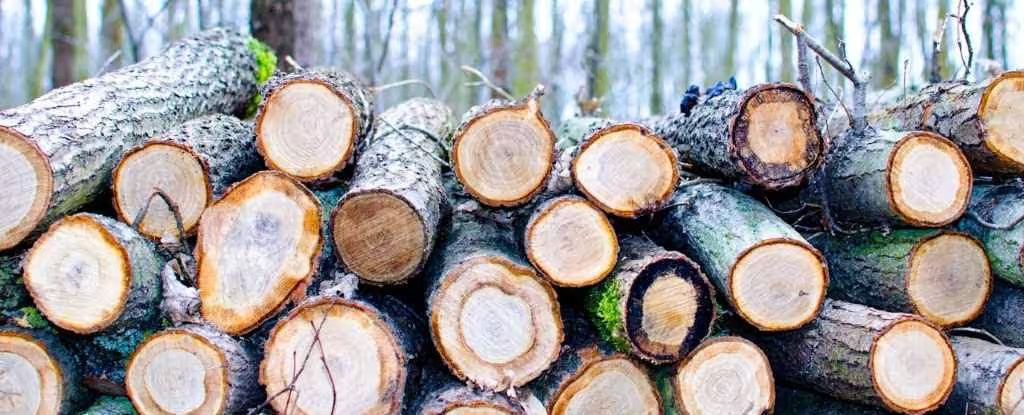
Why Sustainable Wood Sourcing Matters
Demands of the hardwoods are up, yet forests are not unlimited. The idea of sustainable sourcing of wood is to find a balance between human demands and the need to maintain ecosystems.
- Responsible sourcing facilitates renewable timber cycles and not depletion of old growth.
- The ecological health is taken care of by forest management practices (thinning, selective harvesting, replanting).
- Deforestation-free wood ensures you are not causing forest destruction.
- Systems such as forest certification and Wood chain of custody enable buyers to trace the timber from forest to product.
These are the practices that support long-term supply chain, not just green branding.
What Is a Board Foot? The Core of Timber Measurement
To know how to calculate board feet, it is important to know what a board foot entails.
A board foot (BF) is a unit of volume that is equal to a board, which is 1-inch thick x 12 inches wide x 12 inches long. That’s 144 cubic inches. This measure is taken to equalize unequal dimensions to make boards comparable.
Here’s the classic formula:
Board feet = (thickness in inches) x (width in inches) x (length in feet) ÷ 12.
In case length is in inches, then:
Board Feet = (Thickness × Width × Length in in) ÷ 144.
Applying those formulas regularly will make your board foot per board values correct and that is very important when combining boards or bargaining with suppliers.
Step-by-Step: Board Feet Calculation by Wood Species
Board feet are computed in a mechanical way–but there is variation in species of wood. The following is an effective way to combine species-specific considerations.
Step 1: Measure nominal vs actual dimensions
Most boards are sold with nominal dimensions (e.g., “2×4”), but machined to smaller sizes (e.g., 1.5×3.5). When finishing surfaces, it is always advisable to use actual dimensions to prevent any form of miscalculation.
Step 2: Apply the Formula correctly
Select the right variant of the formula in order to keep wood volume measurement integrity:
- The feet-based version is used when the length is in feet.
- The inches-based version should be used when all dimensional measurements are taken in inches.
Step 3: Adjust for Shrinkage and Moisture Content
Woods shrink at varying characteristics. The difference between kiln dried wood and green wood should be considered:
- The degree of drying shrinkage in volume is expected to be 5-8 percent.
- Use that buffer prior to the ordering or utilization of BF estimates.
Step 4: Consider Species Yield and Waste
All the species are not alike in the neatness of their milling. Wood yield factors differ:
- There are hardwoods that produce more wastes due to knots, grain or faults.
- Some other species (such as certain domestic species) have better utilization.
Always calculate an estimate yield buffer based on the species you are dealing with.
Step 5: Multiply by Quantity
If buying multiple boards:
Total BF = BF per board × number of boards
It is just simple arithmetic-but precision in Step 1-4 compounds at scale.
Step 6: Estimating the weight where required
If you wish to know the weight of your order:
To avenue yourself of the weight of your order:
- Convert BF → cubic feet (divide by 12)
- Multiply with density of wood species (in lb/ft3)
- You get wood weight per board foot across the order
For example, oak has a range of densities of 45-56 lb/ft3 (see wood density tables). (EngineeringToolbox – wood densities)
This aids shipping cost estimation and structural planning.
Step 7: When working with Logs: Log Scaling Techniques
Assuming that your timber is in the log form, then you will require log scaling rules to estimate the number of board feet that will be produced on milling. Common approaches include:
- Doyle Log Rule – very popular. is prone to underestimate small logs. (Global Timber on Doyle rule)
- Scribner Rule – a rule of diagram, more balanced for medium logs
- International 1/4-inch Rule – more consistent across sizes
You’ll find conversions and comparisons among these rules in the forestry references (see Purdue Extension log scaling guide). (Purdue FNR-191 PDF)
These log scaling schemes refine your BF estimate even before you had a glimpse of the logs.
Real-World Anecdote: The Walnut Slab Miscalculation
Jared, a coworker of mine, gave a bid on a beautifully figured walnut slab in a timber auction. The listing said “200 BF.” Once it was delivered, cracks and warp as well as shrinkage decreased the usable lumber to around 160 BF. Raw board feet numbers can be very misleading as Jared found out when he did not account for buffers in shrinkage, defects and yield. Since then, he never fails to deduct 10% and place bids. That discipline saved him some money in various projects.
Wood Species Density: Differences, Tables & Impact
Wood species density is a significant variable in the estimation of weight and the shipping cost. Some key facts:
- Density determines weight of wood per board foot.
- Denser woods such as oak or walnut may make the same size pine weight two times heavier.
- The open wood density tables are available and include e.g. Global Wood Density Database (World Agroforestry wood density database).
- The species density values are also aggregated in the USDA i-Tree Appendix. (USDA wood density values)
Cross match density numbers and validate shipping weights using these resources.
Sourcing Eco-Friendly & Certified Wood
Technical perfection matters – but sustainable sourcing is your competitive advantage.
Certified Wood: FSC, PEFC & More
Find certified wood as this represents ethical sources. The most recognized systems:
- Forest Stewardship Council (FSC) This is a strict certification ensuring forests are run in an ecologically sustainable manner (FSC certification info)
- PEFC (Programme for the Endorsement of Forest Certification) – is a validation structure applied globally.
Certified wood helps fight illegal logging and promotes wood supply chain without any deforestation. (See The Spruce description of FSC certification standards). (What does “FSC-certified” mean?)
Chain of Custody: Tracking Wood Metadata
Without traceability, certification is meaningless. Always insist on chain of custody for wood which will trace all the movements from the forest to the final product. This is the transparency associated with plausible forest certification systems.
Local and Reclaimed Wood Options
- Reclaimed Wood (old barns, floors, beams) may have a character to it and be less costly to the environment.
- Local sourcing of wood reduces transport emissions, promotes forestry in the region as well as allows close monitoring of sustainability.
- Composite woods / engineered wood (i.e., cross-laminated timber, MDF, glulam) can minimize waste and utilize species of lower grades more efficiently.
Reclaimed + local + certified sources are great sources of sustainable impact when applied together.
Worked Example: “Calculate Board Feet for Walnut Cabinet”
Suppose you are to make a walnut cabinet using 8 boards each of size 5/4” x 8” x 10’.
- Measures actual dimensions: 1.25-inch × 7.9 inches × 120 inches.
- Compute board feet per board: 1.25×7.9×10 / 12 = 8.27BF
- Subtract shrinkage & yield buffer (say 8%): usable ≈ 7.61 BF.
- Multiply by quantity: 7.61 × 8 = 60.9 BF usable.
- Estimate weight (e.g., walnut density ≈ 40 lb / ft3):
Cubic ft = 60.9 ÷ 12 = 5.075 ft3 → Weight ~ 5.075 × 40 = 203 lb
- Check sourcing: request supplier to use FSC-certified walnut or use reclaim boards.
Its weight, cost, and sustainable measure can be compared to oak or pine optionally.
Pitfalls, Tips and Best Practices
- Always use actual dimensions and not nominal
- Include buffers for wood shrinkage and moisture content
- Remain consistent with your board foot formulas
- Use log scaling rules when dealing with raw logs
- Use wood density tables to determine weight
- Demand certified wood and ask for chain of custody.
- Leverage reclaimed wood and local wood sourcing
- Know the yield and wastes of the species before cutting
- Be aware of tropic wood legality particularly for exotic hardwoods
Frequently Asked Question (FAQs)
Q1: What is a board foot and why is it used in lumber measurement?
Answer: A board foot is a unit of volume that is used to measure lumber: one board foot equals a board 1 inch in thickness × 12 inches in width × 12 inches in length (or 144 cubic inches). It is commonly utilized since it takes into consideration the thickness, width and length unlike in linear or square feet which do not take into consideration their thickness. Using board feet ensures fair pricing and a consistent measurement of timber when it comes to different species and sizes of boards.
Q2: How do I calculate board feet for different wood species (accounting for density and moisture)?
Answer: Board feet are calculated by using the following formula:
Board Feet = (Thickness in inches × Width in inches × Length in feet) ÷ 12
In case you have dimensions in inches only, divide by 144 instead of 12.
There is however a variation in the density, shrinkage and moisture content of the different wood species. For example:
- Wood species that are denser (such as oak or walnut) weigh more per board foot.
- Green wood vs kiln-dried wood means fresh wood may shrink by as much as 5-8 percent when dried.
- In all your estimation, you should always make a slight lower, so as to cover the shrinkage and moisture content, as well as wastes in the wood.
Weight can be estimated with help of wood density tables and can be adjusted on the plan.
Q3: What’s the difference between nominal vs actual dimensions in lumber?
Answer: Nominal sizes are the conventional ones such as “2×4” or “4×6” but when the finishing (planing) is done, the size becomes smaller. For example, a 2×4 board may be with real dimensions of 1.5” x 3.5”. In order to determine accurately the board foot per board, one must always consider the actual milled size, not the nominal one. Misusing of nominal size causes an overestimation of lumber volume and price.
Q4: What are log scaling methods (Doyle, Scribner, International) and when do I use them?
Answer: Log scaling can give you an idea of how many board feet the raw log will yield once milled. Common rules include:
- Doyle Rule- tends to underestimates smaller logs.
- Scribner Rule – more suitable with medium logs.
- International1/4-Inch Rule- more consistent across log sizes.
When purchasing logs as opposed to sawn boards, one of these scaling methods is used initially to estimate the yield at pre-milling. This aids you to size orders, bargain with mills and to predict species output and waste.
Q5: How can I ensure the lumber I use is sustainably sourced and certified wood?
In order to have responsible sourcing:
- Select certified wood under such initiatives as FSC (Forest Stewardship Council) or PEFC which verify ecological, social and economic standards.
- Authenticate the wood chain of custody to be able to know where the wood originates to the finished product.
- Enquire your supplier about forest management practices (replanting, controlled harvesting, impact minimization).
- Prefer reclaimed wood, or prefer local wood sourcing /engineered wood / composite woods where feasible.
- Ensure that forestry is being managed in a manner that does not produce deforestation-free timber outcomes and promote renewable woods.
Projects such as building the airport have already shown that it is able to insist on transparent sourcing of wood in millions of board feet. For example, the Port of Portland contracted wood locally, within 300 miles and tracked forest-to-frame procurement. (Sustainable Northwest case, PDX terminal)
Final Thoughts
Computing the board feet of various wood species is one of the basic skills. And with a sustainable sourcing of lumber, you bridge that with your craftsmanship becoming a contributor in real-world change.
Each cut, each order and each supplier decision count in the forests, whether it is the renewable timber cycles, or wood under deforestation-free outcomes. Combine your technical accuracy with ethical sourcing and your activity would be a part of a healthier and lasting supply chain.
Explore More Calculators
Looking for more handy tools? Try these other calculators from MegaToolCalculator.com:
- Board Foot Calculator
- Master Board Foot Measurements
- Mastering the Doyle Rule
- Coast FIRE Calculator
- Weighted Mean Calculator
- Rucking Calorie Calculator
- Batting Average Calculator
- Topsoil Calculator Calculator
- Chronological Age Calculator
- Exponential Growth Calculator
- Lap Day Calculator
- Point Buy Calculator
Discover even more tools in our All Calculators section.