
The Ultimate DIY Guide: How to Build a Cinder Block Wall with Confidence
One of the most satisfying projects that a person can engage in as a DIY masonry task is learning how to construct a cinder block wall. Stone, concrete and appealing wall in your outdoor space can be built with the appropriate planning, equipment and a definite procedure. It can be a garden wall, a retaining wall, or it might be a part of your backyard landscaping projects but either way, this cinder block wall construction guide will take you through it all – the planning and all the way up to its completion.
Why Building a Cinder Block Wall Is Worth It
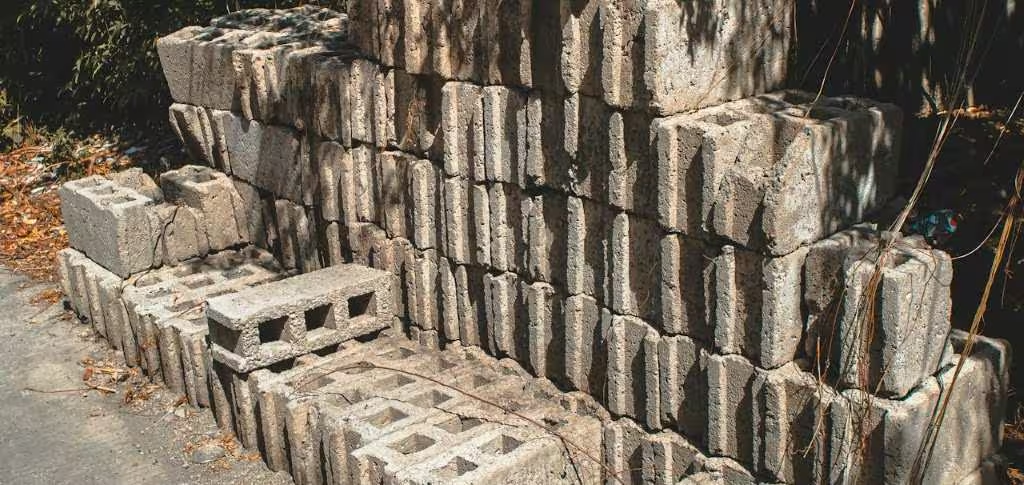
A cinder block wall that can be built by yourself is more than a weekend project it is a long term investment in your home. Cinder block also called concrete masonry unit (CMU) is strong, economical and very adaptable. They are ideal when it comes to a construction of a wall outdoors, construction of garden walls, or a cheaper retaining wall.
You may often hear that a properly built wall may last many decades with little maintenance since it is made of concrete blocks. By paying attention to the long-lasting wall maintenance, you ensure your work pays off.
Cinder Block Wall Tools and Materials Checklist
In order to begin your project, prepare all the tools and materials needed when building the cinder block walls. Good preparation is a money saving practice.
Materials
- Cinder blocks – Estimate your requirements with a cinder block wall cost calculator and add 5-10 percent for waste.
- Mortar for cinder block wall- Select a combination of suitable mix ratio of mortar to ensure strength and durability.
- Concrete footing – Pour a solid base, this is the base of your wall.
- Cap blocks – These give your wall a clean, finished appearance and they assist in the protection against water on your wall.
- Rebar strengthening – Add steel bars in hollow cores to enhance strength particularly for taller walls.
- Grout filling – Serves to strengthen the wall internally particularly when the wall is being used in a retaining wall made out of cinder blocks.
Tools
- Shovel or trenching machine (for digging the footing trench)
- Trowel (for applying mortar)
- Wheelbarrow or mixing tub
- Chalk snap line (used in marking straight layout lines)
- 4-foot level (verify that the wall is plumb and level)
- Rubber mallet (to tap blocks into place)
- Mason’s String line (Keeping alignment of each row)
- Concave jointer (for finishing mortar joints)
- Masonry protective equipment – gloves, dust mask, goggles.
(See a detailed tool list for masonry for reference.)
Step 1: Planning and Building Permits
Always check building permits and codes, before you break ground. Walls more than 4 ft may need permission, rebar reinforcement, or engineering approval. Always call your local authority before you start, it will save you a lot of money in the rework later.
Use stakes and string to draw your outline. A chalk line is used to make the outline straight. Note: proper planning results to an easier construction.
Pro tip: Early consider about proper wall drainage. A lot of wall collapses occur due to the pressure of water behind the wall.
Step 2: Excavating and Preparing the Concrete Footing
A solid cinder block wall foundation is key to durability.
Digging the Trench
- Excavate the trench beneath the footing depth, as well as frost line (which depend on location).
- Make it about twice the width of your blocks (e.g. 16” wide for an 8” block). See the guide about footings of the manufacturer.
- Pour concrete when the base has been compacted.
Pouring the Footing
- Mix high-strength concrete, and pour it into your trench, taking care that it is flat.
- Let it cure for 48-72 hours then place blocks. This treatment gives strength to the structure.
- As one of the Reddit DIYers underlined, neglecting a proper footing is risky business. Reddit
Your concrete footing is like the backbone of your wall – do not skip or hurry it.
Step 3: How to Lay Cinder Blocks – The First Course
After the footing has dried it is time to know how to place cinder blocks like a pro.
- Dry-fit your first row. Place the blocks without mortar to ensure that the alignment is all right with your chalk line and your level.
- Mix your mortar with the right mixture of mortar (refer to the instructions on the bag).
- Apply mortar to the bottom and the sides of every block – this is your bonding agent.
- Lay the blocks one after another, tapping into their place with your rubber mallet.
- Check for level and plumb after every two three blocks. Small errors here will accumulate.
This stage sets the tone for the whole wall – do it slowly and do it properly.
Step 4: Building a Cinder Block Wall Step by Step
It is time to get down to the construction of a cinder block wall step-by-step – the core of the project.
Stagger the Blocks: Running Bond Pattern
Apply running bond pattern – each block has an overlap with the one underneath. This will assist in the distribution of loads and enhance strength. It is one of the major principles of masonry design. Do the same thing across each course.
Apply Mortar & Grout Filling
- Following each course, apply mortar using a mix ratio of mortar that you have chosen.
- Insert grout filling into the hollow cores where required (mostly in load bearing walls).
- In such cores, use rebar reinforcement to meet the code in a vertical way.
Install Rebar Reinforcement
This is one of the most important steps to follow if you are constructing a higher or structural wall:
- Insert steel bars (rebar) vertically into hollow blocks at interval.
- Fix them on the footing so that they anchor down.
- Once in place add grout to the core to make it more stable.
It is this aspect that makes a simple garden wall to be different to one capable of supporting structural loads.
Check Level and Alignment Regularly
After each course:
- Run a mason’s string line along the top.
- Check the front to back and side to side plumbness using the level.
- Use the rubber mallet to make changes if needed.
Small mistakes in the beginning will cost you later.
Step 5: Finish the Wall with Cap Blocks & Details
When your wall reaches the desired height, finish it cleanly:
- Place cap blocks on top with mortar for a neat edge.
- Use a concave jointer on the mortar joints in order to make rounded joints that have a professional finish.
- Wipe away the excess mortar while it is still workable – it hardens later.
- Consider applying sealant for weather protection to prolong the life of your wall.
The finishing touches are as important as the foundational ones.
Drainage, Backfill & Long-Lasting Wall Maintenance
Great walls are not merely constructed, they are maintained.
Drainage & Backfill
- Backfill behind your wall with clean gravel in order to facilitate drainage, not soil or clay.
- Add a perforated drain pipe if your wall is retaining soil or on a slope- this is necessary in a cinder block retaining wall. Learn more from this detailed retaining wall guide.
- Keep planting and water sources from the upper edge to prevent root damage or moisture intrusion.
Maintenance for Longevity
- Check annually for cracks, movement or staining.
- Reseal joints and clean when necessary.
- Pay attention to the concrete block wall lifespan and what you can do to extend its life (such as maintaining the drainage in good conditions, not loading it with heavy weight without reinforcement, etc.).
Cinder Block Wall Cost Estimate & Budgeting
The knowledge of what your cinder block wall is going to cost you per square foot is the major factor in keeping within your budget.
Component | Typical Cost (USD) |
Cinder blocks (per block) | $1.50 – $3.00 |
Mortar mix (per bag) | $10 – $20 |
Concrete footing & prep | $100 – $200+ depending |
Rebar & grout filling | $10 – $15 each piece |
Total installed (DIY) | Roughly $15 – $30 / sq ft |
So, for a 10 x 6 ft wall (60 sq ft) you are likely to spend about $900 – $1800 in materials (labor is you!). An initial good estimate will assist in planning your project to have fewer surprises.
DIY Masonry Projects and Home Renovation Tips
If it is your first project in DIY masonry work, then begin small. Experiment with a low garden wall or planter made out of concrete masonry units (CMUs). After you feel at ease, you can work up to bigger and more complicated projects such as a complete home remodeling or a functional outdoor building.
Here’s an anecdote:
A house owner chose to create a project of a backyard garden wall building with 100 blocks. They did not take the drainage into account, and the first row shifted slightly. They paused and repaired it, put in additional and better back-fill and drainage, and the wall still stands strong eight years later-proof that taking the time early pays off later.
Let your initial project be a learning experience, and not a hurry job.
Safety Practices for Outdoor Wall Construction
Safety should never be an afterthought in outdoor wall construction:
- Safety equipment should always be put on when doing masonry work, gloves, goggles and mask when cutting blocks.
- Use your legs not your back to lift blocks.
- Avoid building in the freezing weather; mortar will not cure properly.
- Make sure that your trench is stable and check your footing depth and frost line to prevent shifting.
By honoring the process and your safety, you will avoid pitfalls and remain on the right side.
Frequently Asked Questions (FAQs)
Q1: How much does it cost to build a cinder block wall?
Answer: Prices of cinder block wall construction are determined by a number of factors: height of the wall, length of the wall, reinforcement and finishing. A DIY project will require a material cost of approximately $15 – 30 on average per square foot. As an example, a 10-foot by 6-foot wall may cost about $900 -$1800 in materials. By employing a contractor, labor will come on top of this. The block type, rebar reinforcement, grout filling, size of footing and special finishes (stucco, paint and veneer) are considered to be the key factors that influence cost.
A realistic cinder block wall estimation cost will be obtained by planning and including the cost of waste, extras, and permit/inspection fees.
Q2: Can I build a cinder block wall myself (DIY cinder block wall)?
Answer: Yes – it is possible to construct a DIY cinder block wall in case you are ready to use some tools, some heavy lifting, and follow the steps of the construction process. Such a project can be implemented on shorter, non-load-bearing walls (such as: garden walls, boundary walls). But when the wall is more than 4 ft. high, retains soil or will have a load-bearing (e.g., part of a building), then you need to think about hiring someone. Such construction factors as building permits, building codes, depth of footing and frost line, rebar reinforcement, and effective wall drainage, are critical in large construction buildings. Having the correct cinder block wall tools and materials and a detailed construction guide about building the cinder block wall, you will be well ready to succeed.
Q3: What size should the footing be and how deep below the frost line?
Answer: The wall feet is the underlying concrete base your wall is going to be on, the cinder block wall footing, and should be of the appropriate size to be stable. One of the rules: the footing width must be at least twice the width of the block (in case of 8-inch blocks, it is roughly 16 inches). In addition, the trench depth must also be lower than the local frost line, such that freezing/ thawing does not cause the movement of your footing. For example, your region will have many footings 8 inches thick and not less than 16 inches wide, and sunk down until they reach below the frost line. This makes sure that the base of your wall is firm and firmly held. In the absence of this, the walls might sink, tilt, or crack.
Q4: When and how should I use rebar and grout filling for reinforcement?
Answer: Provided that your wall is not merely decorative (say, a cinder block retaining wall), you will be interested in rebar reinforcement and grout filling that will make it tough. Here’s how and when:
- Once you have poured the footing and are starting to stack up blocks, put vertical rebar bars into the hollow cores of the blocks at regular intervals (usually on a regular basis such as every few feet). The bars should be attached into the footing.
- After the blocks have been reinforced around the rebar fill in the hollow cores with grout (a mixture that is resilient to concrete). This transforms the hollow blocks into power pillars that are reinforced.
- Install standard blocks on a running bond (staggered joints) so that the joints are not line-aligned and thus make the structure weak.
- Always review your local building permits and codes since most of the areas will demand such reinforcement in a tall or load-bearing wall.
This way, you shall have much more stability in your wall, much higher load bearing capacity, and it shall be acceptable structurally.
Q5: How long will a cinder block wall last and what maintenance does it need?
Answer: When built and well maintained correctly, a well-constructed cinder block wall can have a lifespan of 50-80 years or even longer. Lifespan is dependent on materials, foundation, drainage, reinforcement, as well as the environment. To maintain the walls in a long-lasting manner:
- Proper drainage of the wall should be made to ensure water does not accumulate behind and under the wall (of particular concern to retaining walls).
- Check cracks, bowing or deterioration of mortar joints and correct where necessary on an annual basis.
- In the event that your blocks are placed under freeze-thaw cycles, make sure that the footing is below the frost line in order to prevent the shifting.
- Sealant or paint may be added, and top cap blocks should ensure that the wall is not exposed to the intrusion of water.
These steps will help you when building your concrete block wall so that it is strong, stable and looks good throughout its life.
Final Thoughts on Building a Cinder Block Wall
Knowing the process of constructing a cinder block wall step by step provides you with the liberty to makeover your property affordably and confidently. Using the proper tools and materials that are right in constructing cinder block wall, proper drainage of the wall, and a steady mix ratio of mortar, and the reinforcement where necessary can help you construct a strong, weather resistant and beautiful wall that can withstand the test of time.
Whether you are enhancing your landscape, or creating some privacy, or just looking at the possibilities of a retaining wall that is both affordable and economical, in any case, it all starts with just one block-and a bit of determination.
Explore More Calculators
Looking for more handy tools? Try these other calculators from MegaToolCalculator.com:
- Cinder Block Calculator
- Lap Day Calculator
- Rucking Calorie Calculator
- Board Foot Calculator
- Batting Average Calculator
- Topsoil Calculator Calculator
- Chronological Age Calculator
- Exponential Growth Calculator
- mg to ml Calculator
- Percent Error Calculator
- Reverse Sales Tax Calculator
Discover even more tools in our All Calculators section.