
Board Foot Calculator: The Smart Science & Proven Technology That Saves You Time and Money
Woodworking, carpentry and construction require as much of measurement and planning as they are about creativity. Measurement of lumber and estimation of wood volume is at its core. A board foot calculator is not just an ordinary tool because it helps in closing the divide between theory and practice so that you can simplify your efforts, reduce error margins, and organize materials in a more efficient way. Here, we will breakdown it and determine what it is, how it works and why everyone must use it as a pro or a hobbyist.
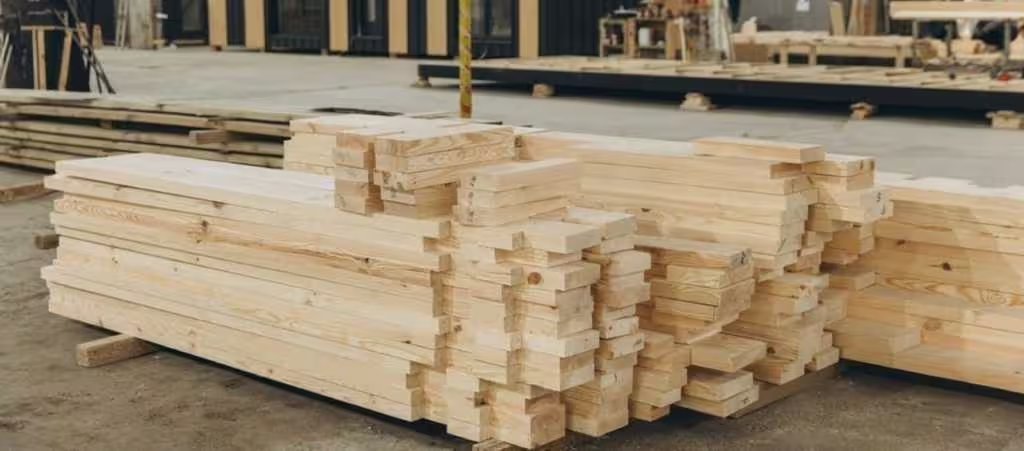
Board Foot Calculator Explained: What Is a Board Foot?
A board foot is a standard unit of the lumber volume used mostly in the U.S and Canada. One board foot equals:
1 inch thick × 12 inches wide × 12 inches long = 144 cubic inches (Wikipedia)
With this idea, you have the ability to compare boards of various dimensions instead of using a different scale. As explained by Wood-Mizer, board foot is a wood measurement for a piece of lumber that is 12 inches wide, 1 ft long and 1 inch thick. (Wood-Mizer)
In practice, a large number of wood suppliers use nominal vs actual lumber sizes: nominal sizes (such as “2×4”) are used in board foot calculations, despite the fact that the actual dimensions are smaller.
Why Manual Estimation Often Fails
On paper, the formula of board feet is simple. However, it is risky to do it manually:
- Confusion of units (inches vs feet vs metric)
- Round-off errors accumulating in a large number of pieces.
- It is a pain to add dozens of parts manually, with high error possibilities.
- Irregular shapes or warped boards do not fit the formula of rectangle all too well.
- Error of typing, omission of entries, or skipped lines.
On one occasion, an order of kitchen was once tallied manually in a woodshop and overbought by 12%. The unused wood was not re-usable, which incurred time, space and money. When this was changed over to digital calculator, errors were reduced by a large margin.
A digital board foot calculator is reliable in conversions, batch entries, and summations – it has removed human errors of arithmetic.
How Digital & Online Board Foot Calculators Work
The modern lumber volume calculators (web or application based) often include the following features:
- Input thickness, width, length, and quantity.
- Unit conversion (e.g., inches to feet) is automatic.
- Instant total board footage
- Option of cost per board foot, generating material cost estimates.
- Capability to include a waste buffer (to take into consideration cuts, defects, or errors)
The Omni Board Foot Calculator is an example of an online calculator that has a clean interface. Hardwood Industries also provides a Board Footage Calculator so that the users are able to plan their ordering.
One more is BoardCalculate.com, which allows you to list various boards and also receives estimates of costs.
These tools make manual math a process – with increased speed, consistent and scalable.
The advantages of board foot calculator
1. Time Savings & Efficiency
The tool does all that in a moment as opposed to having to do it one by one. This is helpful with projects that have numerous parts.
2. Improved Accuracy in Lumber Estimation
There are no longer conversion unit errors or rounding errors. Your correct estimation of lumber becomes your strong foundation.
3. Budget Control and Cost Estimation
Enter the price per board foot and the tool returns the real-time estimates of your material cost. It comes in handy when quoting your clients or to estimate your budget.
4. Waste Minimization & improved Yield of Materials
Having the knowledge of the exact quantity of wood required (with a reasonable margin) lowers overstocking, that is, less scrap and more productive use of material.
5. Fair Comparison between Suppliers
Price comparison of lumber is possible when the suppliers base their quotations by board foot.
6. Scalability for Projects Big or Small
The same calculator may be utilized for a DIY Shelf or for entire building framing.
7. Inventory and Material Tracking
In the case of shops or contractors to keep track of stock in terms of board footage is more significant than merely counting boards of varied size.
Step-by-Step: How to Use a Board Foot Calculator Correctly
Here is a reliable method you can follow:
1. Measure your Boards precisely
Take measurements of thickness and width in inches, length in feet (or other consistent units).
2. Select or Ensure Correct Unit Mode
There are calculators which accept mixed units, and some which need consistent units.
3. Enter Quantity for Identical Pieces
In case you are using multiple boards of similar sizes, use the quantity field.
4. Execute the Calculation
The tool provides the board feet per line and adds up to provide the total board footage.
5. Add a Waste Buffer
As a rule, an addition of 5-15 percent, or even more in the case of grain matching, knots, or intricate cuts.
6. (Optional) Cost per board foot
Numerous calculators allow you to enter cost in order to get the total material cost.
7. Audit Some Entries Manually
Check some of the calculations manually to ensure that the tool is functioning properly.
In such a way, doing so would help you streamline your workflow and prevent numerous pitfalls.
Real Examples & Anecdotes
Example: Crafting a Tabletop
You will require three boards, each 10 ft. long, 8 in wide, 2 in. thick.
- Formula: (2×8×10) ÷ 12 = 13.333 (2 × 8 × 10) ÷ 12 = 13.333 (2×8×10) ÷ 12 = 13.333 board feet per board
- Total: 13.333×3 = 4013.333 × 3 = 4013.333×3 = 40 board feet
If you mis-enter 9 ft, instead of 10 ft, you will only have 36 board feet and that is an underestimation by 10 percent. One can be confident that his or her calculation will be right using a calculator.
Example: Framing a Wall
Dimensional boards that are sold as “2×4” are 1.5 in x 3.5 in. Suppose you require 50 boards of 10 ft length:
- Board feet per stud: (1.5×3.5×10) ÷ 12 = 4.375(1.5 × 3.5 × 10) ÷ 12 = 4.375(1.5×3.5×10) ÷ 12 = 4.375
- Total: 4.375×50=218.754.375 × 50 = 218.754.375×50=218.75 board feet
This calculation from board count to lumber volume enables you to make a purchasing decision with confidence. (Procore)
Workshop Anecdote
One of my friends in a furniture shop once delivered a quote that underestimated wood requirements by 8 percent. The project faced a shortage of materials in the middle of the construction. Once a board footage calculator in spreadsheet form was adopted, the calculations of quotations became more accurate and the profit margins were increased.
Frequently Asked Questions (FAQs)
Q1: What is a board foot and how is it different from a linear foot?
Answer: The unit of volume that is used in lumber industry is a board foot. It is a 1-inch-thick piece of wood, 12 inches wide and 12 inches long or 144 cubic inches. (Wikipedia)
A linear foot (or lineal foot), on the contrary, is a measurement of length only, 12 inches along a straight line, but not in reference to width or thickness. The two are mixed up by many beginners yet they are used differently in the pricing and measurement of lumber. (J&W Lumber)
When a lumber yard says “10 linear feet” they are talking of length. When they are saying 10 board feet they mean volume – which is more meaningful when dealing with boards of different dimensions.
Q2: How do you calculate board feet for a board or piece of lumber?
Answer: This formula would be used to compute the board feet:
Board feet = (thickness in inches x width in inches x length in feet) ÷ 12.
(Or, with inches as the unit of length also: divide by 144)
For example a board which is 2 in thick, 8 in wide and 10 ft long will provide:
(2×8×10) ÷ 12 = 13.33(2 × 8 × 10) ÷ 12 = 13.33(2×8×10) ÷ 12 = 13.33 board feet (Sons of Sawdust)
This formula is used in numerous online board footage calculators and lumber volume calculators. (Hardwood Industries)
Q3: Why use a digital board foot calculator instead of doing it manually?
Answer: A board foot calculator (an online calculator, an app or a spreadsheet) has multiple benefits:
- Minimized error: It is the automation of unit conversions and summation and will eliminate errors associated with processing math.
- Speed: It works with many pieces simultaneously and wastes less time on more significant projects.
- Cost estimation: Numerous calculators permit entering a cost per board foot and then receiving a sum of the cost of the material immediately.
- Waste management: You have an option of adding waste buffer so that you make enough to cover defects or cutting wastage.
- Comparisons: It enables you comparing the offers of various suppliers (they generally quote lumber by board foot). (net)
In short: small jobs can be handled manually, whereas large jobs benefit better with the use of digital tools and minimization of risks.
Q4: How many board feet are in common lumber sizes like 2×4 or 2×6?
Answer: This is one of the questions that are posed the most by the woodworkers. Since nominal sizes are frequently used in calculating the real size of standard lumber, they are measured at the actual size though the size is quoted using the nominal size.
For example:
- A 2×4 board (nominal) of 10 ft:
(2×4×10) ÷ 12 = 6.667(2 × 4 × 10) ÷ 12 = 6.667(2×4×10) ÷ 12 = 6.667 board feet - A 2×6 × 10 ft board:
(2×6×10) ÷ 12 = 10(2 × 6 × 10) ÷ 12 = 10(2×6×10) ÷ 12 = 10 board feet
The various conversions that the boardcalculate.com site lists can be useful (boardcalculate.com)
These tables allow you to be able to look at volume per linear foot of various sizes of boards quickly.
Q5: How much extra wood (waste buffer) should I include when ordering lumber based on board feet?
Answer: No one cuts perfectly. you will have had saw kerfs, and irregularities of the grain, and off-cuts. Waste buffer, which is frequently suggested, is 5-15 percent of the calculated board footage, based on complexity.
In the case of simple, straight cuts, 5 per cent may do. When dealing with complex joinery, good matching or irregular cuts, then the target is 10-15 percent (or higher). This will make sure you have some leeway in terms of cutting errors or board wastages.
This buffer can be included in your estimate so that you are not hit by costly reorders or lose time in the middle of the project.
Summary & Final Takeaways
- Board foot calculator is a tool that automatizes the lumber measuring and estimation of wood volume.
- The formula of board foot is: Board Feet =Thickness (in) x Width (in) x Length (ft) / 12.
- Digital calculators do not make mistakes with units, sum many boards, and facilitate cost estimations.
- It has the advantages of saving time, enhanced accuracy, less wastage, and enhanced budgeting.
- Use the step-by-step guide to making sure the usage is reliable.
- Watch out for caveats such as irregular boards and supplier rounding.
- Select or create tools of batch entry, cost assistance, unit transformation as well as buffer.
- Future trends include AR, AI, and integration of the tools using cloud syncing.
Explore More Calculators
Looking for more handy tools? Try these other calculators from MegaToolCalculator.com:
- Board Foot Calculator
- Master Board Foot Measurements
- Mastering the Doyle Rule
- Coast FIRE Calculator
- Weighted Mean Calculator
- Rucking Calorie Calculator
- Batting Average Calculator
- Topsoil Calculator Calculator
- Chronological Age Calculator
- Exponential Growth Calculator
- Lap Day Calculator
- Point Buy Calculator
Discover even more tools in our All Calculators section.