
Mastering Board Foot Measurement: The Ultimate Guide to Accurately Calculate Board Feet for Your Projects
In matters of woodworking or construction, knowing how to determine board feet is a very important skill. Building a custom furniture or deck floor requires the accurate measurement of the board foot so that you can estimate the amount of lumber you need to buy and avoid excessive purchasing of lumber and take the success of your project to the end. In this paper we will take you through the entire process on what to know about board foot calculation, board feet formula, hints on precise lumber measurements, and how to prevent errors.
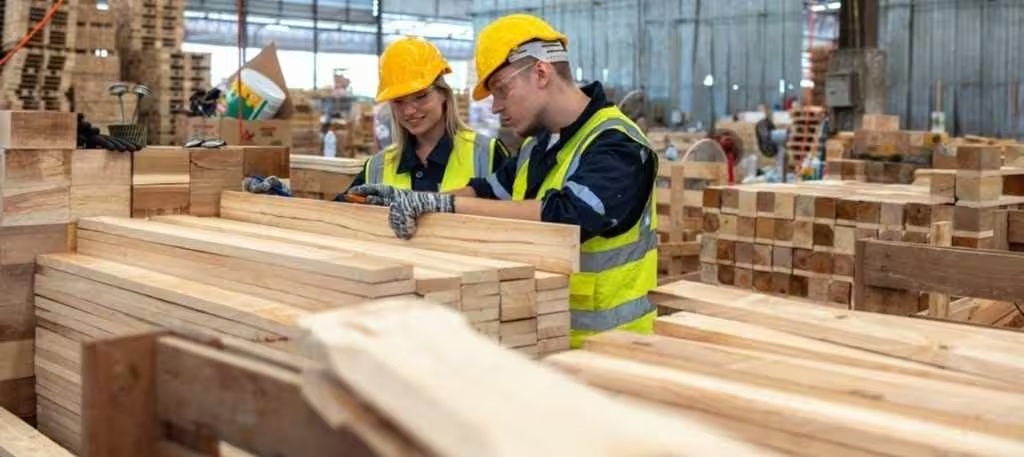
What Is a Board Foot? Understanding the Board foot definition
A unit used to measure the lumber quantity is called a board foot. This is necessary in the lumber business because it assists it to set the price per board foot. A board foot can be described as a piece of timber that is 1 inch thick, 1 foot wide and 1 foot long.
To be more exact, 1 board foot is equivalent to 144 cubic inches or 1/12 of cubic feet. The measurement is used in the process of buying wood particularly at lumberyards because it uses a standard price that does not depend on the type and thickness of the lumber.
How to Calculate Board Feet: The Board Feet Formula Explained
It is easy to know how to calculate board feet just after knowing board feet formula. The formula will help you determine the volume of the lumber depending on the length, width and thickness.
Board Feet Formula:
The general calculation of board foot is the following:
Board feet = (Length in feet × Width in inches × Thickness in inches) ÷ 12
To understand how to calculate board feet of different types of lumber, let us break it down using a simple example:
Example: Calculating Board Feet for a 2×4
- Length: 10 feet
- Width: 3.5 inches (nominal size of 2×4)
- Thickness: 1.5 inches (actual thickness for 2×4).
Using the formula:
Board feet = (10 x 3.5 x 1.5) ÷ 12 = 4.375 board feet
This 2×4 board would give 4.375 board feet.
Common Types of Lumber and Their Board Feet Measurements
Now we will discuss computing some of the most common types of lumber used in woodworking and construction, and finding their board feet. No matter the type of work you are doing, 2×4 board feet calculation, or decking lumber calculation, understanding these measurements will help you get the right amount of wood for your project.
1×4 Lumber: This is a Widely used Woodworking Lumber
Shelving or paneling is normally performed on a 1×4 board. Actually, a 1×4 board has a thickness of 3/4 inch and a width of 3.5 inches. To find the board feet of a 10-foot 1×4 board, this is obtained by calculations:
- Length: 10 feet
- Width: 3.5 inches
- Thickness: 0.75 inches
Board feet = (10 x 3.5 x 0.75) ÷ 12 = 2.1875 board feet
Thus, a 10 feet 1×4 board would yield 2.19 board feet of lumber.
2×6 Lumber: Construction Decking Lumber Calculation
The 2×6 is commonly utilized in framing or deck construction. Now, although 2×6 boards usually have a thickness of 1.5 inches and width of 5.5 inches, given that the length is 10 ft, we can compute the board feet of a 10-ft 2×6 thus:
- Length: 10 feet
- Width: 5.5 inches
- Thickness: 1.5 inches
Board feet = (10 x 5.5 x 1.5) ÷ 12 = 6.875 board feet
For this calculation, a 2×6 board gives 6.875board feet.
Step-by-Step Guide for How to Measure Board Feet in a Log
The calculation may be more complex in case you deal with rough lumber or logs. But the board feet can yet be estimated by simple formulas, or by applying the Doyle Rule of measurement for logs.
The following is the computation of the board feet in a log:
- Measure diameter of log at its smallest end (in Inches).
- Measure the length of the log in feet.
- Calculate it more accurately with the use of Doyle Rule or the International 1/4-inch rule, or apply the simplified formula:
Board feet = ((Diameter – 4) ÷ 4)2 × Length
Example: Log with 12 inches diameter and 8 feet long:
Board feet = ((12 – 4) ÷ 4)2 × 8 = 16 board feet
That gives you approximately of 16 board feet in the log.
Board Foot Calculation for Custom Furniture Lumber and Decking Projects
When constructing your own furniture or when doing a decking project, it is essential to know how to compute the board feet to make sure that you have sufficient wood to do your project and that you do not overuse the materials.
- Custom Furniture: If you need a dining table of maple, you would wish to compute the amount of board feet you need depending on the size of pieces. For example, the maple board was 30 inches in width, 72 inches long and 2 inches in thickness; this would need 30 board feet.
- Calculation of decking Lumber: In decking, the understanding of board feet of your 2×6 boards helps to calculate how much wood you will use to cover your deck.
Eliminating Avoidable Pitfalls in the Calculation of the Board Foot
Even the seasoned woodworkers can make mistakes in calculations of the board feet. The following are some of the most typical errors:
1. Incorrect Unit Conversion
Always use feet for length and inches for widths and thickness. Errors are highly likely to be committed by the confusion of these units, and leading to wrong calculations of the board feet.
2. Not Accounting for Thickness Variations
Nominal sizes such as 2x4s are not the actual size. The correct thickness and width should always be used to compute the board feet (e.g., 1.5 inches thick for a 2×4 board).
3. Failing to Consider Kiln-Dried Lumber Drying Shrinkage
When you are dealing with kiln-dried lumber, you should know that it shrinks slightly as it dries. This will impact on your calculation of board feet and therefore you have to plan accordingly particularly when you are using a green lumber as a measurement.
How to Use a Board Feet Calculator Tool for Fast Calculations
A board feet calculator tool will save you time in case you are in a hurry or when calculating with a significant amount of lumber. These web-based applications enable you to find the board feet of lumber of any type, without knowing the formula and having to compute it on your own. All that a person is to do is to feed the calculator with dimensions and receive a result immediately. It comes in particularly handy in a big job such as framing a house, or constructing a deck.
Estimating Lumber Costs Using Board Feet Measurement
You can also estimate the price of your lumber by learning how to figure out how many board feet to multiply the price by and use it to figure out the total value of the lumber you will need. A lot of wood is sold in lumber yards and the price of lumber is per the board foot, hence understanding of the board feet will assist in keeping you within your pocket.
For example, if 2×6 boards costs $6 per bd ft; and you require 6.875 bd ft for a piece of decking, then:
The cost of that lumber would be 6.875 x 6 = $41.25.
Frequently Asked Questions (FAQs)
Q1: What Is a Board Foot and How Is It Calculated?
Answer: A board foot is a unit of lumber measurement, representing a volume of 144 cubic inches or the volume of 1 foot long by 1 foot wide by 1 inch think. Board feet are calculated using the formula below:
Board Feet = (Length in feet × Width in inches × Thickness in inches) ÷ 12
For example: 2×4 board that is 8 feet long would be:
(8 x 4 x 1.5) ÷ 12 = 4 board feet.
Q2: How Do I Use a Board Foot Calculator?
Answer: The calculation of the volume of lumber is made easier by a board foot calculator. Enter the sizes of your board i.e. length in feet, width and thickness in inches, and the calculator will determine the board feet. As an example, when an individual uses the Omni Calculator by entering a 2×4 board that is 8 feet in length he will get 4 board feet.
Q3: What Are Common Board Foot Measurements for Standard Lumber Sizes?
Answer: The following are common dimensions of board feet of normal sizes of lumber:
- 1×4 (¾” × 3½”): 0.25 board feet per linear foot
- 2×4 (1½” × 3½”): 0.5 board feet per linear foot
- 2×6 (1½” × 5½”): 0.75 board feet per linear foot
- 2×8 (1½” × 7¼”): 1 board foot per linear foot
The measurements can be applied to assess the lumber requirements in construction works such as decking or framing.
Q4: How Do I Calculate Board Feet for a Log?
Answer: A common way of estimating the board feet in a log is the Doyle Log Scale that is used in the U.S. The formula is:
Board Feet = ((Diameter inches – 4) ÷ 4)2 x Length in feet
For example, a log of 12-inch diameter and 10 feet long would be:
((12 – 4) ÷ 4)2 x 10 = 16 board feet.
This computing gives an approximation of yield of a timber from a log.
Q5: Why Is Understanding Board Foot Measurement Important?
Answer: Board foot measurement is essential to ensuring that estimates of lumber requirements are made correctly, that the budget is made correctly, and the purchasing of materials is not excessively or insufficiently done. It will make sure you will get the correct amount of wood to do your project, whether that be furniture, decking or framing. It is also useful in price comparison among suppliers because lumber is frequently sold in terms of board feet.
Conclusion: Mastering Board Foot Measurement for Successful Woodworking Projects
To recap it all, learning how to compute board feet is critical to both the woodworkers and to all other people who participate in construction projects. Be it a custom-made furniture, framing a house or just a project of laying out a decking, a bit of knowledge of lumber measurement will see you purchase the correct quantity of wood and still maintain your budget.
Always measure twice, and calculate once, but the one thing to remember is to take into consideration shrinkage of lumber as it does not dry straight away, and you may at times go wrong with your calculations in board feet. Knowing this means that you can easily enter any lumberyard and make the right purchase for you next project.
Explore More Calculators
Looking for more handy tools? Try these other calculators from MegaToolCalculator.com:
- Board Foot Calculator
- Coast FIRE Calculator
- Weighted Mean Calculator
- Rucking Calorie Calculator
- Batting Average Calculator
- Topsoil Calculator Calculator
- Chronological Age Calculator
- Exponential Growth Calculator
- Lap Day Calculator
- mg to ml Calculator
- Percent Error Calculator
- Reverse Sales Tax Calculator
- Point Buy Calculator
Discover even more tools in our All Calculators section.