
How Many Calories Does Rucking Burn? A Powerful Rucking Calorie Burn Guide by Weight, Speed & Distance
If you have ever completed a ruck, and then asked yourself, “How many calories does it burn compared to walking?” – you’re not alone. Rucking looks to be a simple act. You’re just walking.
But, once you factor in the weight of your backpack, pace, distance and terrain, rucking becomes an effective form of low impact cardio that can dramatically increase the amount of energy being expended.
This guide breaks down rucking calorie burn in a clear and honest way – using science, real world examples, as well as helpful advice that you can start using immediately.
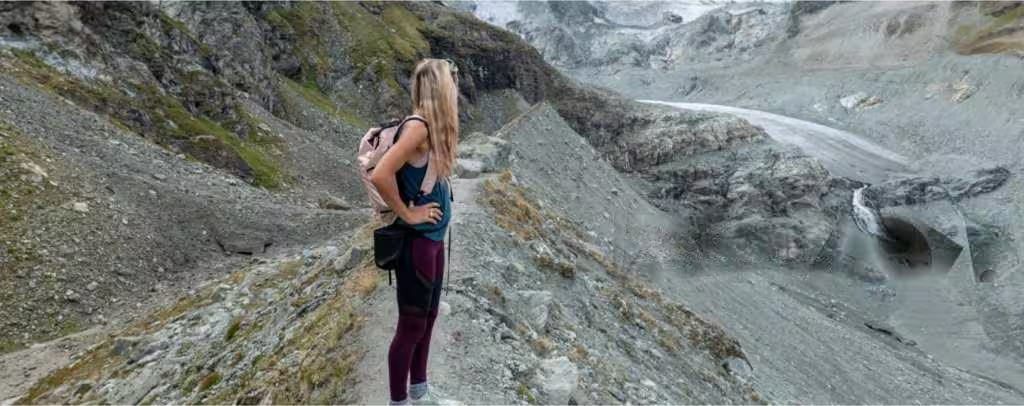
What Is Rucking? (Weighted Walking Explained)
Rucking is a type of weighted walking in which you carry extra weight, and most often do so in a rucksack, weighted vest, or a backpack while walking a distance.
The term comes from military rucking, where military personnel walk long ruck marches while carrying heavy loads of equipment.
Today, rucking is popular due to its ability to incorporate the cardio vs strength training into one effective activity.
How Many Calories Does Rucking Burn? (Quick Answer)
On average, rucking burns 2-3x more calories than does walking.
Typical estimates:
- Walking: 250-350 calories/hour
- Rucking: 500-900+ calories/hour
The factors which determine how many actual calories are burned rucking are:
- Body weight
- Backpack weight
- Pace
- Distance
- Terrain and elevation gain
- Fitness level
Why Rucking Calorie Burn Is Higher Than Walking
Rucking With Weight Increases Energy Expenditure
With load, your body is forced to:
- Support more mass
- Stabilize posture
- Generate more force per step
This is called load carriage and is a well-studied concept in exercise physiology and military science.
This is the reason why rucking weight calories are far greater than walking calories.
More Muscles Are Recruited
Rucking activates:
- Core stabilizers
- Upper back and Trapezius Muscles
- Glutes and hips
The more the muscles are working the more energy is used.
Heart Rate Zones Increase Faster
With added load, your heart rate increases at a faster rate so it moves you into higher heart rate zones.
This prolongs your aerobic activity, particularly zone 2 cardio – often referred to as the fat burning zone.
How Rucking Calories Are Calculated
Metabolic Equivalent (MET) Explained
A number of estimates are based on metabolic equivalent (MET) values:
- 1 MET = resting energy use
- Walking = ~3-4 METs
- Rucking = ~6-9+ METs
The more the METs the more calories burned.
Military Rucking Models
Advanced equations (like Pandolf) are used by military researchers that take into account:
- Body weight
- Backpack weight
- Pace
- Incline / slope
- Terrain
Recent research has demonstrated that earlier models were lower in estimating calorie expenditure during increased loads and speeds.
Rucking Calories Per Hour (By Weight & Pace)
Backpack Weight | Rucking Calories per Hour |
10 lbs | 400–500 |
20 lbs | 500–600 |
30 lbs | 600–700 |
40 lbs | 700–850 |
50 lbs | 850–1,000+ |
Increasing pace multiplies these numbers.
Rucking Calories Per Mile (By Distance)
Distance | Calories Burned Rucking |
1 mile | 120–180 |
3 miles | 350–550 |
5 miles | 600–900 |
8 miles | 1,000–1,400 |
Longer distance = more time under load.
Rucking vs Walking Calories (Direct Comparison)
Activity | Calories per Hour |
Walking | 250–350 |
Rucking | 500–900 |
Running | 700–1,000 |
Rucking burns more calories and is also a joint friendly activity.
Calories Burned Walking With a Backpack vs Rucking
The number of calories burned walking with a backpack is increased slightly but rucking involves:
- Heavier load
- Intentional posture
- Faster pace
Which burns much more calories.
Terrain, Incline & Elevation Gain Matter More Than Weight
- Flat terrain = lowest burn
- Incline/slope = significant increase in calories.
- Trails, sand, snow = increased instability and increased cost of energy.
Terrain and energy cost explained
Step-by-Step: How to Burn More Calories Rucking
Step 1: Start Light
Begin with 10-20 lbs
Step 2: Increase Distance First
Protect joints and develop stamina.
Step 3: Add Weight Gradually
Increase by 5 lbs/week
Do not go over 1/3 of body weight.
Step 4: Increase Pace
Target 15-17 min/mile (3.5-4 mph)
Step 5: Add Hills
The greatest calorie multiplier is elevation gain.
Rucking for Weight Loss: Does It Work?
Yes. Rucking is effective for weight loss since it:
- Burns calories efficiently
- Preserves muscle
Increases basal metabolic rate (BMR) with time.
Walking vs Hiking vs Rucking
Activity | Calories Burned |
Walking | Low |
Hiking | Moderate |
Rucking | High |
Rucking is a combination of the hiking’s terrain challenge with the load.
Rucking Calorie Calculators: Are They Accurate?
Specialized rucking calorie calculator is not perfect – but it is practical.
It helps track:
- Trends
- Comparisons
- Consistency
Frequently Asked Questions (FAQs)
Q1: How many calories does rucking burn per mile?
Answer: The average body burns about 120 to 180 calories per mile, which is determined by body weight, weight of the backpack, speed and the terrain.
Increased loads, speed and increased elevation gain may push calorie burn further. Rucking also consumes more calories per mile than normal walking by about 50-100 percent.
Q2: Does rucking burn more calories than walking?
Answer: Yes. Rucking uses a lot of calories as compared to walking due to the added weight. Rucking can burn up 2-3 times as much calories as walking at an equivalent pace. The weight added to the rucksack raises muscle activity, heart rate and total calorie expenditure, making rucking much more efficient in burning calories.
Q3: How many calories does rucking burn per hour?
The number of calories burned per hour rucking varies from 500 to 900+ and depends on:
- Body weight
- Backpack weight
- Pace
- Terrain and incline
Compared to that, walking usually burns on average 250-350 calories per hour and rucking is one of the most effective low-impact cardio exercises.
Q4: Is rucking good for weight loss?
Answer: Yes, Rucking is excellent for losing weight. It is a low impact exercise with a high number of calories burnt and is joint friendly. Rucking is also good at building muscle which causes an increase in basal metabolic rate (BMR) in the long term- allowing you to burn even more calories at rest. A significant number of individuals are able to maintain rucking over time compared to running.
Q5: Are rucking calorie calculators accurate?
Answer: A rucking calorie calculator provides a useful approximate, not a precise figure. Even though some details, such as heat, terrain difficulty, sleep, or fitness level are not taken into full consideration by a calculator, they are highly effective in:
- Tracking progress
- Comparing workouts
- Estimating the trends in calorie burn
To achieve the most optimal results, one should use a calculator that considers the body weight, the weight of the backpack, pace, and distance.
Final Thoughts
Rucking offers:
- High rucking calorie burn
- Cardio + Strength in one rucking workout
- Low joint stress
- Long-term sustainability
You’re still walking. You have just made it much more efficient.
Explore More Calculators
Looking for more handy tools? Try these other calculators from MegaToolCalculator.com:
- Rucking Calorie Calculator
How Backpack Weight Powerfully Impacts Calories Burned While Rucking for Faster Fat Loss
- Audiobook Speed Calculator
- Board Foot Calculator
- Batting Average Calculator
- Cinder Block Calculator
- Chronological Age Calculator
- Exponential Growth Calculator
- Lap Day Calculator
- mg to ml Calculator
- Percent Error Calculator
- Reverse Sales Tax Calculator
Discover even more tools in our All Calculators section.